Inside Yala: The Future of Finance
Venture into the Global Landscape
Insights, guides, and expert updates on finance automation, global payments, and AI-powered accounting for businesses.
Global PayoutsAI AccountingGlobal Collections
•
•
•
•
•
•
Insights, guides, and expert updates on finance automation, global payments, and AI-powered accounting for businesses.
Abisola Adeyemo
Content associate
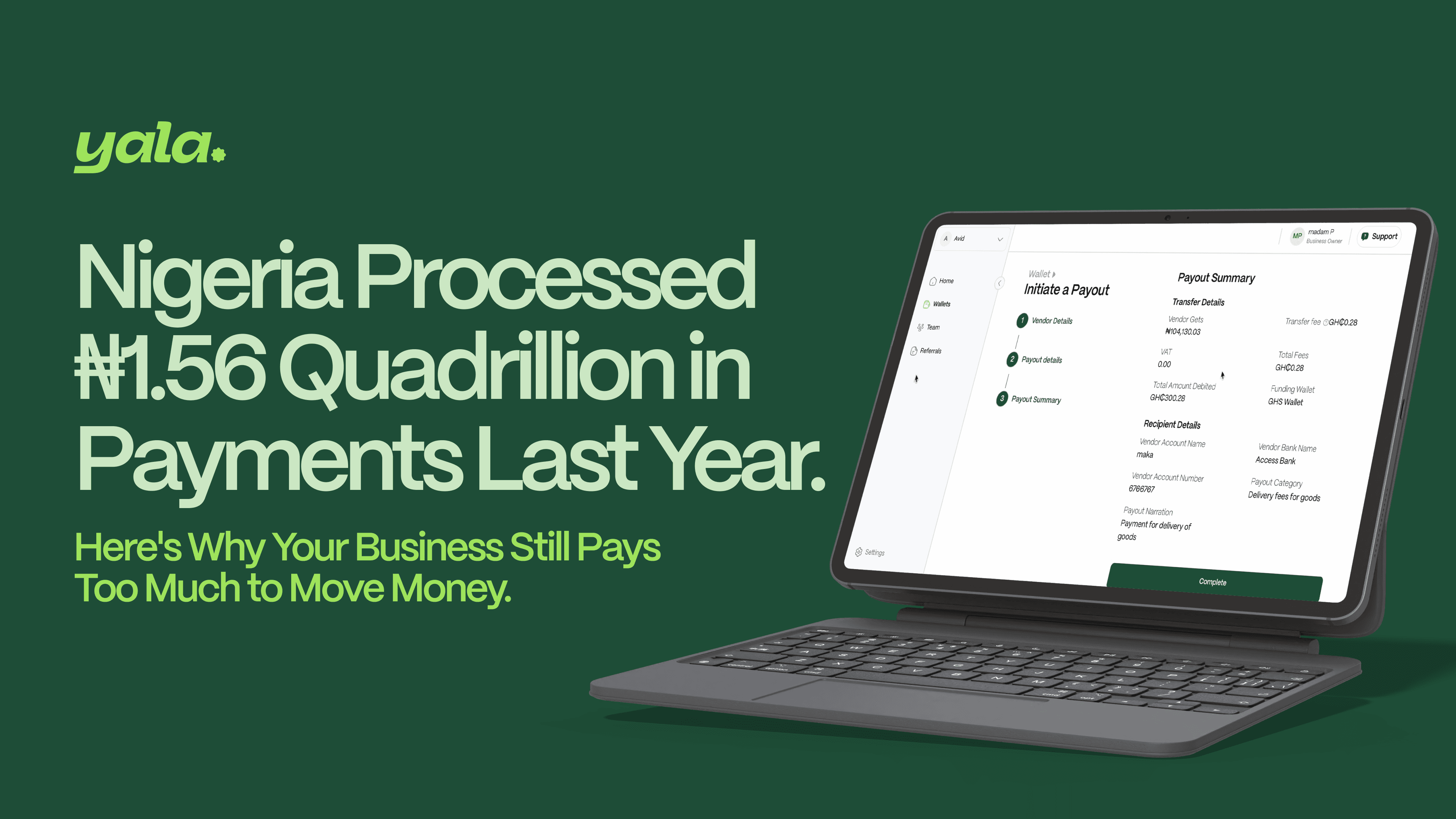
Nigeria processed over ₦1.56 quadrillion in electronic payments in 2025, making its payment infrastructure one of the most active real‑time payment ecosystems in the world. Yet for many Nigerian businesses, sending money to a supplier abroad still takes days and costs far more than it should. Domestic transfers are nearly instant. But once money crosses a border, businesses often face multiple intermediaries, hidden foreign‑exchange spreads, and settlement delays that tie up working capital. This gap between domestic payment efficiency and cross‑border payment friction is one of the biggest financial inefficiencies facing Nigerian businesses today.
Nigeria’s NIBSS Instant Payment (NIP) system continues to scale rapidly. In Q1 2025 alone, ₦284.99 trillion in transactions were processed, representing a 22% increase year‑on‑year. Nigeria now ranks among the top real‑time payment ecosystems globally, completing over 12 billion instant transfers in 2024.
The launch of the National Payment Stack (NPS) in 2025, built on the global ISO 20022 standard, further modernized Nigeria’s payment infrastructure, enabling improved interoperability and preparing the country for faster regional settlement. For domestic transfers, this progress is transformative. But the moment payments move internationally, businesses encounter a very different system.
Most international payments from Nigeria still travel through the SWIFT correspondent banking network. Instead of moving directly between countries, the payment may pass through multiple intermediary banks, often in Europe or North America, before reaching the final recipient. Each step introduces additional fees and delays. A payment from Lagos to Accra, for example, may first route through London or New York, converting currencies multiple times before arriving. What should be a regional transfer can take several days and cost significantly more than expected.
According to the World Bank’s Remittance Prices Worldwide report, the average cost of sending $200 within Sub‑Saharan Africa is about 7.9%, nearly three times the UN target of 3%. For businesses that make regular supplier payments, these costs compound quickly.
Traditional cross‑border bank transfers rarely show the full cost upfront. Instead, fees are distributed across several layers:
For a business sending $50,000 per month to overseas suppliers, these combined costs can easily exceed $24,000 per year. The issue is not just pricing, it is lack of transparency.
Nigeria’s exchange‑rate unification reforms reduced the gap between official and parallel FX markets, but volatility remains a key challenge for businesses. In 2025–2026, estimates show the parallel market premium averaging 12–15% over official rates. For businesses unable to consistently access official FX channels, this premium effectively becomes a hidden tax on international trade.
Equally important is timing risk: when exchange rates fluctuate significantly between payment initiation and settlement, businesses can lose margin on transactions they already priced. For many finance teams, locking FX rates at the moment a payment is initiated is now considered a best practice.
Nigeria’s Tax Act 2025, which came fully into effect in January 2026, introduced major reforms affecting international payments. One of the most significant provisions concerns export proceeds. Profits from exported goods can qualify for income‑tax exemptions, but only if the proceeds are repatriated through official financial channels. Businesses using informal FX routes risk losing these exemptions. This means that payment infrastructure is no longer just a cost decision, it is also a compliance decision.
Businesses increasingly need payment systems that provide:
New infrastructure is emerging to reduce cross‑border friction. One major development is the Pan‑African Payment and Settlement System (PAPSS), launched under the AfCFTA framework. PAPSS enables African businesses to settle cross‑border transactions directly in local currencies, removing the need for multiple USD conversions. At the same time, modern cross‑border fintech platforms are introducing faster and more transparent payment models.
Compared with traditional bank transfers, these platforms often provide:
For companies that import goods, pay international suppliers, or receive payments from foreign clients, several realities are becoming clear:
The infrastructure to move money globally is improving, but businesses must actively choose the systems that reduce cost and increase transparency.
Yala is built to help Nigerian businesses send and receive international payments more efficiently. With transparent FX pricing, faster settlement rails, and payment infrastructure designed for cross‑border trade, businesses can reduce hidden fees and move money with greater certainty.
Your cross‑border payments should work as hard as your business does.