Inside Yala: The Future of Finance
Venture into the Global Landscape
Insights, guides, and expert updates on finance automation, global payments, and AI-powered accounting for businesses.
Global PayoutsAI AccountingGlobal Collections
•
•
•
•
•
•
Insights, guides, and expert updates on finance automation, global payments, and AI-powered accounting for businesses.
Abisola Adeyemo
Content associate
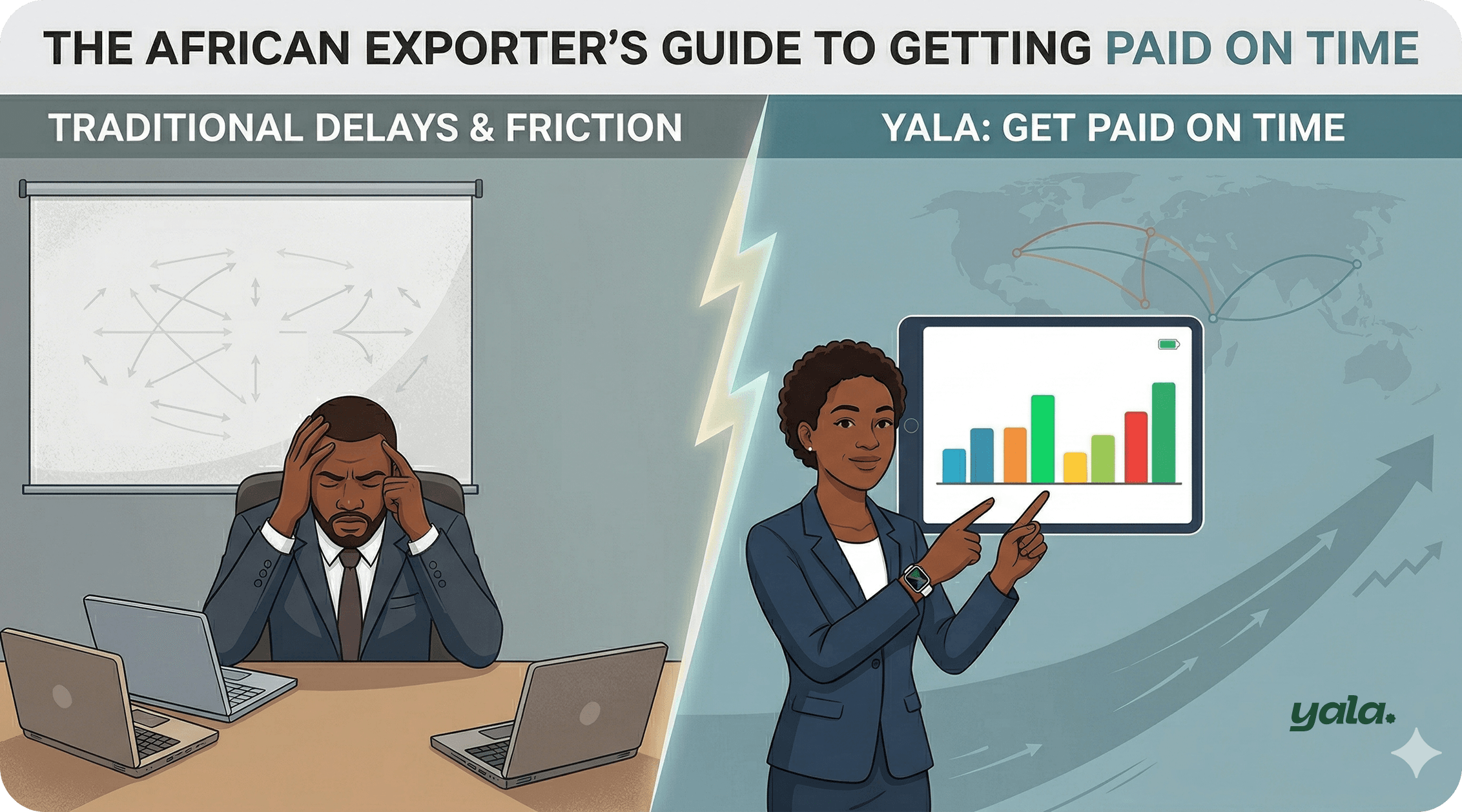
You shipped the goods. You sent the invoice. The buyer confirmed receipt. And then, silence. Days turn into weeks. Emails go unanswered or get buried under "we're processing it." Your working capital is sitting somewhere in transit, locked inside someone else's payment cycle, while you figure out how to cover your next production run.
This is not a fringe experience. For African exporters, whether you're moving goods from Lagos to London, Accra to Amsterdam, or Nairobi to New York, late international payments are practically a line item on the balance sheet. And the causes are rarely random.
Here's what's actually happening, and what you can do about it.
A significant chunk of delayed payments trace back to a simple problem: the invoice wasn't right. Wrong currency, missing purchase order references, descriptions that don't match the buyer's records, incorrect tax or VAT treatment, any of these can send your invoice into a review loop that takes weeks to clear. International buyers, especially in Europe and North America, operate within strict procurement and compliance workflows. If your invoice doesn't match their system, it doesn't get approved. It gets queried. The buyer may not even tell you immediately. You follow up, they mention "a small discrepancy," and suddenly you're three weeks behind.
In many Western markets, net-60 and net-90 payment terms are standard, not exceptional. Buyers in these regions structure their entire cash flow management around paying suppliers as late as contractually allowed. That's not malice. That's how their treasury teams are trained to operate.
What this means for you: the invoice you sent expecting payment in two weeks is sitting in a queue that won't be processed for sixty days. And if you didn't explicitly negotiate shorter terms up front, you don't have much leverage after the fact. Add in different banking cut-off times, public holidays that don't align with Nigerian or Ghanaian calendars, and approvals that require multiple signatories across time zones, and your payment gets pushed further.
Even after a buyer approves and initiates payment, cross-border transactions often run through correspondent banking networks that can take three to five business days, and that's on a good day. If the payment passes through multiple intermediary banks, gets flagged for compliance screening, or hits a currency corridor with limited liquidity, it can stretch further.
For exporters invoiced in foreign currency, there's another layer: by the time the payment settles, the FX rate has moved. What started as a USD payment that made sense at ₦1,450/$ might land differently by the time it converts. You planned around one figure and received another.
Here's the uncomfortable truth: most African exporters manage receivables through a combination of spreadsheets, email threads, and phone calls. It works, until it doesn't.
When you're managing five active buyers across three continents, knowing which invoices are overdue, which are disputed, and which are simply waiting for a finance cycle requires a level of real-time visibility that manual processes can't provide. Things slip. Follow-ups come too late or feel too aggressive. And because the relationship matters, you hold back, and wait longer than you should.
The exporters who collect reliably aren't always the ones with the biggest legal teams or the most aggressive terms. They're the ones who've removed the friction from the payment process, for themselves and their buyers.
With Yala's invoicing tools, you can create, manage, and send invoices directly from the platform, with embedded payment links your buyers can act on immediately. You invoice in naira, collect in NGN or stablecoins, and Yala settles you in whichever currency works for your business. No more chasing FX quotes after the fact.
On the receivables side, Yala's AI agents work like a dedicated collections team, payments match to invoices and post to your books instantly. You get real-time visibility into your entire receivables pipeline: what's pending, what's overdue, and what's cleared. The result isn't just faster payments. It's fewer disputes, less manual work, and a cash flow position you can actually plan around.
Ready to take your receivables off autopilot? See how Yala's accounts receivable tools work